One impressive aspect of this album is Wakeman’s ability to avoid this becoming a Wakeman keyboard show. He has seemingly given himself a secondary role compared to the guitarists.
It must be a double-edged sword being the musical son or daughter of a famous musician. On one hand, your name is instantly recognisable, and that must open certain doors. However, it could be difficult to escape the shadow of the parent, especially when the parent in question is a larger-than-life living legend by the name of Rick Wakeman. But Rick’s son Oliver has built up quite a considerable reputation of his own over 30 years, including a spell himself with Yes, and a number of high-profile collaborations (Clive Nolan, Steve Howe, Gordon Giltrap, and many others).
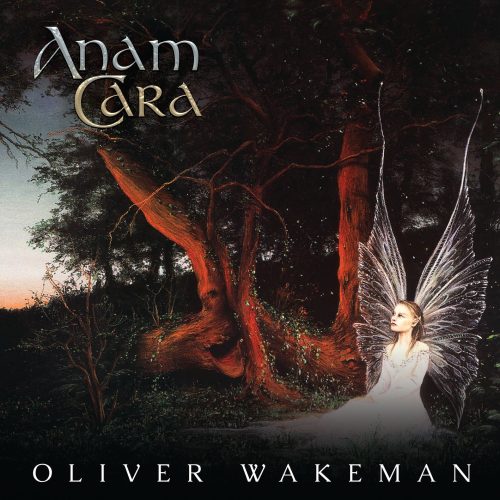
One thing Oliver shares with his father though is the ability to traverse genres and surprise you with the unexpected, and that’s exactly what he has done here: Anam Cara (which translates to ‘soul friend’ in Gaelic) is an album of Celtic folk/rock music, inevitably with a progressive rock twist. While it’s true Oliver Wakeman did release a Gaelic inspired instrumental album back in 2001 (3 Ages Of Magick), this time around he has a top-class vocalist in Hayley Griffiths and a selection of illustrious guest musicians, and the result is a more mainstream and accessible album.
The opening words sung by Hayley Griffiths are ‘Here I sit with my heart on my sleeve, wondering if you will arrive’ which in a way sums up the introspective nature of the album. Wakeman pointed out in a recent interview with Velvet Thunder ‘It isn’t a set of love songs, but it does have a theme in as much as the songs are all about relationships and human interactions’. That opening song, The View From Here, has a lovely acoustic folky feel to it, providing support to an impressive vocal performance by Griffiths. It could easily be a track by Renaissance. There is a whiff of the stage about this song, and I’m not sure whether that’s due to Griffiths theatrical background (in Riverdance) or just Wakeman’s melodies. Of course, Wakeman himself is no stranger to theatrical projects, as demonstrated in his Hound Of The Baskervilles collaboration with Clive Nolan.
Next up is the superb The Queen’s Lament, which to these ears is the standout track on the album. It’s a slow-paced acoustic piece, again very much folk-based. It’s beautifully sung by Griffiths, and beautifully produced – especially the sparingly used but dramatic percussion and the lamenting sound of the Uilleann Pipes (courtesy of Nightwish’s Troy Donockley). The medieval feel of the piece, especially in the opening acoustic guitar work, is not casual. The song tells the tale of Catherine Howard, prior to her execution by Henry VIII. This is of course the same territory covered by Rick Wakeman in his Six Wives Of Henry VIII suite, but musically it’s closer to the maudlin atmosphere of Fotheringay – Fairport Convention’s song about Mary Queen Of Scots who suffered the same fate as Catherine Howard.
To write a slow-paced but gripping six-minute song such as The Queen’s Lament is not easy, and the proof is in two other tracks – In The Moonlight and Lonely – both pleasant enough tracks but without the quality to merit this sort of length. Added to this is a risk of this album lacking forward momentum by having too many similarly paced slow songs, although that is partly offset by the strongly rhythmic (but still not fast) Miss You Now, and the positively boisterous Instead Of My Fear.
There are three longer tracks that inevitably bring out more of Wakeman’s progressive rock tendencies. Here In My Heart is really just an extended ballad with a lengthy atmospheric introduction and a rousing instrumental section with a very Wakeman-esque Moog solo. Golden Sun In Grey follows a similar pattern with Troy Donockley’s pipes creating a desolate opening atmosphere, and Wakeman contributing a gorgeously shimmering piano solo. The piece is also wonderfully capped by a guitar solo from David Mark Pearce. Marble Arch is the odd one out since it’s much more of a multi-part theatrical piece whose convoluted story is explained in detailed in the above-mentioned interview. One of those parts is an unexpected burst of jazz – interesting, but ultimately contributing to the piece sounding fragmented.
One impressive aspect of this album is Wakeman’s ability to avoid this becoming a Wakeman keyboard show. He has seemingly given himself a secondary role compared to the guitarists. There are a couple of flashes of keyboard wizardry, but his input feels mostly restrained and in support of delivering top-quality songs. This helps make Anam Cara an hour’s worth of relaxing prog-influenced Celtic folk music. Recommended for fans of Iona, and of course fans of both Wakemans – father and son.




No comments! Be the first commenter?