
Ernie’s is not a name many of you at all will recognise, but do bear with me – this is one of the most beautiful and uplifting albums coming out of the early 1970’s school of slightly hippyish country rock espoused by the likes of Crosby, Stills, Nash & Young, The Band and The Grateful Dead in America; and the UK’s bands like Cochise, Gypsy, Roy Harper, Brinsley Schwarz, Family – and the very wonderful Help Yourself. Wondrous and gently alluring with that distinctively laid back approach based on a strong rural vibe and relaxed mood, this is an album that I’ve been keen to get hold of ever since hearing Ernie on a 1971 United Artists sampler album, All Good Clean Fun. What’s more, a VERY big “hats off” nod to the excellent Esoteric Recordings / Cherry Red double act, not only in remastering and re-releasing it – but doing so at a sensible price rather than the astronomic figures quoted elsewhere…Well Done, guys!
Ernie hailed from Belfast and began his musical career in the 1960s, when he formed Eire Apparent with Henry McCullogh. The band toured extensively, supporting Jimi Hendrix, Pink Floyd & Soft Machine. Eire Apparent only recorded one album Sunrise (1969), which was produced by Hendrix, who also played on the album. Shortly after, McCullough left to tour with The Grease Band and Eire Apparent disbanded. Graham moved in with McCullough and recorded four songs with The Grease Band, but these were never issued. Graham was then signed to Liberty Records as a solo artist. Sharing the same management with Brinsley Schwarz and Help Yourself, they all toured together as “The Down Home Rhythm Kings” package and lived in the same commune in Northwood.
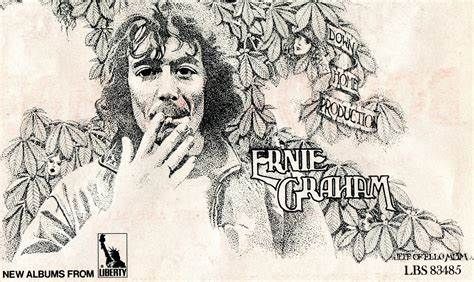
Ernie then recorded this eponymous debut album in 1971, recruiting the members of both Brinsley Schwarz (including one Mr. Nick Lowe) and Help Yourself as his backing band. The album was well received, described as “one of the most hauntingly beautiful” albums of the pub-rock scene and “one of the more distinctive and memorable solo albums of the period”, but sold poorly. After this, Ernie joined the Help Yourselves, appearing with them at the Glastonbury Festival in 1971 and playing on their second album Strange Affair (1972).
In 1973, Graham formed pub rock band Clancy, who issued two albums and a single on Warner Bros. Records. When Clancy broke up in 1976, Graham played with Nick Lowe and tried to go solo, issuing Phil Lynott’s Romeo and the Lonely Girl as a single in 1978, which was his last release. In the early 1980s, he tried forming a band with Larry Pratt, who had briefly been a member of Clancy, but when this failed, he gave up being a professional musician, worked on the railways – including as a guard on the Orient Express! Sadly, his increasing dependence on alcohol caused his health to fail, and he died in London in April 2001.
At the time of its original release, this album drew comparisons with Dylan, The Band and Crosby, Stills, Nash & Young. Ernie’s only solo album is now re-mastered by Esoteric Recordings, accompanied by an eight-page booklet which features extensive liner notes and several rare photographs from the private collection of Ernie’s family. The album has Ernie Graham on guitar and vocals, backed by Brinsley Schwarz (guitar), Bob Andrews (organ, accordion, guitar, piano, harmonies), Ian Gomm (guitar, harmonies), Nick Lowe (bass, harmonies), Billy Rankin (drums) – all from the band Brinsley Schwarz; and Malcom Morley (guitar and vocals), Ken Whaley (bass), Richard Treece (guitar) and Dave Charles (all from Help Yourself)
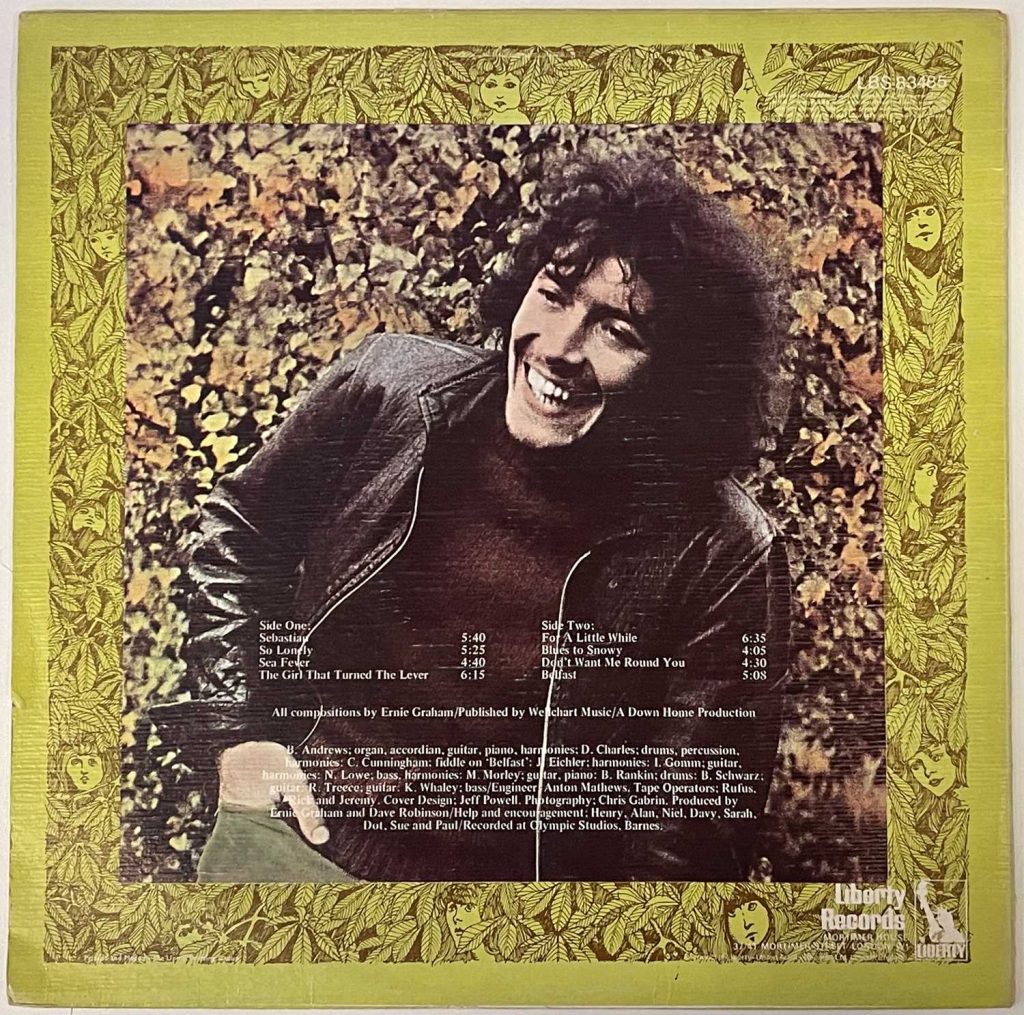
The set opens with Sebastian, straight away infused with those strummed minor chords augmented with delicate lead licks so beloved by Help Yourself. On this track, Ernie produces a dusky drawl of a voice in his singing. So Lonely has more lovely, folky guitar arrangements, with Ernie singing in a smoother, country-ish style and some wonderful lead work from Richard Treece. Truly, I hold Richard right up there in the pantheon of Guitar Gods, I love his understated “noodling”, there’s a real similarity with Richard Thompson about his style.
Sea Fever washes in, appropriately enough, with the gentle ‘rustle’ of waves before a classic 70’s piano “singer-songwriter” vibe takes over. More gentle lead licks illuminate this, along with some nicely understated Hammond organ. Ernie’s voice on this is superb, very laid-back, very hippy-ish, very melodic, very nice. And then we have another gorgeous country-rock number, the oddly named The Girl That Turned The Lever. I haven’t been able to figure the meaning of this, but hey – just sit back, listen to the timeless The Band / The Byrds / Grateful Dead vibes on this one. More wonderful guitar noodling and particularly great harmonies, I would love more details about exactly who plays or sings what on these delightful tunes. Lovely stuff!
For a Little While continues the introspective psych / country-blues vibe, gorgeous harmonies and laid back musicianship soaking through the ether…..wonderfully redolent of those heady days, this could so easily be a Help Yourself album you’re listening to. The “Helps” analogy strengthens as we dive into Blues to Snowy, a track that could be Man in all their pomp, underlining the “one big family” / connections between members of Man, Quicksilver Messenger Service, The Helps, Brinsley Schwarz, and others from the United Artists stable from that time. A pacey beat is unrelenting, then some great spikey lead work takes over – no idea who the star fretman here is!
Don’t Want Me Round You is back into trade-mark country-blues territory, Ernie and the band producing those “faux-western” vocals that were all the vogue at the time. More luscious organ work, more great harmonies, the piano and understated guitar underpinning the whole thing. A simple tune but effective. The song-set is brought to a conclusion by Belfast, Ernie’s ode to The Troubles of those times in Northern Ireland. He lived through part of it and was obviously touched by it. This one is driven by a timeless folk-rock beat, a sinister fiddle throughout, and a slightly odd mix of dark tale in the verses and a “diddly-di” chorus. This could almost be Fairport Convention backing him, the guitar work in particular sounding like early Richard Thompson. Very different from the other tracks, Ernie clearly wanted to give something of his heritage here, as the fiddle fades away it’s an emotive epitaph for the man.
The limited discography left by Ernie Graham is a classic case of “what might have been”, but the music he created with the wonderful assistance of his musical friends on this, his only solo album, features a host of his creative talent and is a wonderful legacy. You probably need to be over a certain age to fully adore this little collection, but I heartily recommend this to everyone!

No comments! Be the first commenter?