
A major triumph … Put simply, if you want an album to walk up to you in the street, stop you and announce forcefully ‘let me introduce myself, I’m Progressive Rock’, then this is the one … It’s big, proud, in-your-face Prog Rock, red in tooth and claw and it doesn’t care what you think. And that’s rather magnificent, wouldn’t you say?
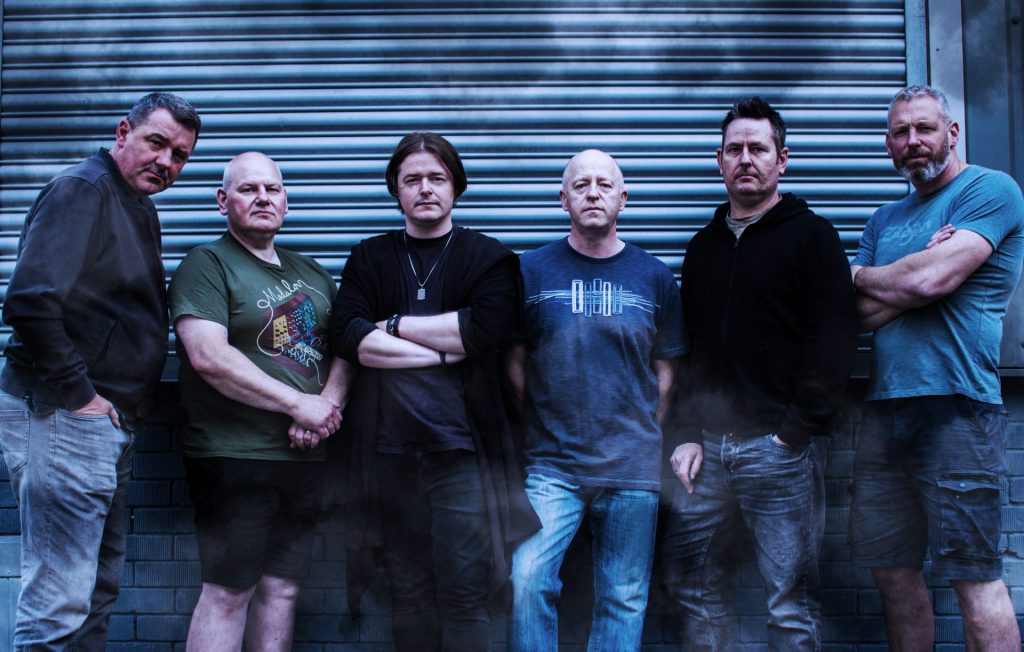
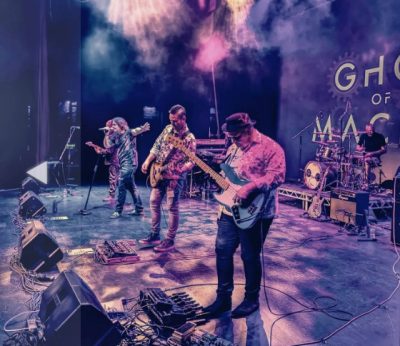
Ghost Of The Machine have been making quite a name for themselves on the UK prog circuit since the release of their excellent debut album Scissorgames in 2022. Formed in 2021, they are appropriately named, since five of the sextet (drummer Andy Milner, bassist Stuart McAuley, keys-man Mark Hagan and guitarists Graham Garbett and Scott Owens) are all former members of another fine staple of recent UK prog, Yorkshire outfit This Winter Machine, joining forces with frontman Charlie Bramald to form the new outfit. Indeed. to emphasise the ‘ghost’ element to the full, it is fascinating that when Bramald stepped in to fill in on vocals for This Winter Machine for a show in 2019, the line up performing that night as TWM were the exact six who now make up GOTM – a ‘ghost Machine’ which never officially existed, indeed.
If the background of those five ex-Machinists gave the band their name and, initially, their ready-made identity, today it is probably the face of Charlie Bramald which is the most recognisable and well known from the band. Indeed, the amount of recent projects and bands he has appeared and guested with is so exhaustive it practically makes Mike Portnoy appear like a workshy layabout who must be encouraged to find employment. You half expect him to turn up on the reverse of the next five pound note – but his boundless energy and appetite for performance has certainly done no harm to this, his central job and real focus, with prog fans the length and breadth of the country having encountered an appearance by ‘Charlie Bramald, from Ghost Of The Machine’, spreading the name and planting it in people’s minds. Even the far from mainstream scene which is prog rock in the 2020s is, at the end of the day, an exposure game when it comes to getting the name out there, which in this case is richly deserved and merited, as this album without doubt builds on the debut in establishing the Ghosties (as nobody will call them) as one of the most exciting and talented bands to be found. Certainly, Scissorgames was an outstanding debut – but this second release improves on it in every conceivable way. It’s a remarkable work.
To call this the follow-up to that first album is accurate in more ways than one. As well as being the second release, it is a conceptual affair which continues directly where the first album’s epic track Scissors left off. After the last would be victim of the evil Puppet King defeated him with the titular scissors, we discover that she went on to take over his throne as the newly crowned Empress Of The Light, and like so many tales of this nature – both fictional and factual, one may add – the adage ‘be careful what you wish for’ becomes true as the cure reveals itself to be worse than the disease. This new tyrant must be dethroned and defeated, to the extent of war and revolution, and we find out the story of, and the fallout from, that conflict here. Meet the new boss, same as the old boss. It’s a rattling good yarn, but if one wished to extrapolate it, a myriad real-world examples could be interpreted as a subtext for the fantasy. But, of course, while a good meaty concept is catnip to many a prog fan, and always has been since the Pretty Things unveiled their rock opera SF Sorrow in 1968 (predating Tommy by some six months, incidentally), that’s only a part of the recipe. The story might be the seasoning, but the heart of the meal is and will always be the music, and how well it fares alone without the trappings. And this manages it in exemplary fashion – as evidenced by the fact that when I first cast an ear over this release I had read nothing of the attendant background information and had no clue of the conceptual nature beyond what I vaguely gleaned – and my opinion of it was as high as it remains now.
Opening the scant six tracks here (few owing to their length, not the album’s brevity, naturally) is the scene-setting nine-minute Keepers Of The Light – and to save you time, if you don’t like this one, then turn the album off and go and play outside; you’re not going to like what’s coming down the pipe either. If however, you do enjoy this track (and to be perfectly honest, it is difficult to imagine any lover of progressive rock not doing so), then this hour or so is going to be some ride. The introduction to this song is as perfectly succinct an opening to a contemporary prog album -that you could possibly wish for – it encapsulates everything in a sort of overture to the genre. A ringing guitar lick ushering the rest of the band in one by one before a shimmering keyboard line is overlaid on top of it releases your prog rock endorphins in a remarkable way. Put it like this: imagine a stridently melodic neo-prog song from the cream of that genre; then think of a keyboard-led instrumental interlude from the ‘golden age’ in the mid-’70s; finally, think of the contemporary sound which recordings can achieve today owing to advances in technology and recording techniques. Now, mentally amalgamate all of those elements. Your mental jukebox has just prepared you for the opening minute of Keepers Of The Light, and it’s as timeless yet classic as you could probably want it to be. Not that things drop from there, as Charlie’s impassioned vocals up things another notch, and heavier influences come in to give things some added heft – although do not go expecting this to stray into progressive metal territory in anything except the briefest of nodding acquaintance. Sure, there are beautifully dirty guitar riffs here which could be grafted onto Sabbath Bloody Sabbath without being rejected by the host, but it is still absolutely, positively, ‘see-this-badge-I’m-wearing-son’ proud to be prog rock and to hand you the paperwork to prove it. It’s just heavy when it needs to be, dramatic and dynamic from the contrast afforded by this, and generally a textbook example of what progressive rock, shorn of capes, hobbits and fluttery pretension, can truly be in 2025. It is what might commonly be known in general parlance as ‘a blinder’. And it sets a high bar for the next track up, which vaults it without breaking stride.
For track two, the more concise six minutes of The Days That Never Were, there is one word I must offer. And that word is ‘Starcastle’. Now, for those who might have missed this rather glorious US prog band who emerged in the mid-to-late ’70s and burned frustratingly briefly, I shall explain what precisely I mean. Starcastle were, effectively, labelled as ‘the new Yes’ or ‘Yes clones’ depending on your point of view, when they arrived in the Yes hiatus of 1975-6. Building their sound on what were indeed some elements shamelessly in thrall to Jon Anderson and co, Starcastle nonetheless managed to find their own, valid niche, taking those foundations and building upon them with a brighter, breezier and more ‘anthemic’ sound than their mentors, full of triumphantly joyous abandon until they crashed and burned after three albums. Now, why the link here? Well, the parallels (Yes pun sadly intended) are marvellously echoed; opening with a bass run so reminiscent of the great Chris Squire that it becomes tempting to do an internet search for news that he faked his own demise, it builds up to a chorus which Charlie inhabits with such relish that it simply takes wings and flies. This is music which may have Yes roots and Starcastle branches, yet flowers into a brilliant display of its own sense of wonder. You’re not enjoying this? Check your pulse now, if it’s not found then that explains it and we’ll send a wreath.
This has by now set things up to fail, and if it seems impossible to the next track to equal these openers, that is the case. It’s better. Panopticon (a type of prison by the way), is to my mind the finest track here. Among a very strong field, it’s basically Usain Bolt – you might be fast, but if he’s in the race you’re second at best. Over the course of twelve minutes this stunning epic utilises some Genesis influences for certain, but completely transcends them. This is so contemporary and immediate-sounding from its shimmeringly gossamer-like intro onward that, despite the occasional Tony Banks keyboard fills, the Hackett-esque guitar work and the Peter Gabriel phrasing of an enthused Bramald, the greatest compliment here is that it would be impossible to imagine that great Genesis line-up recording this music (an unfair analogy because, well, technology – but the point still stands). Standing On The Shoulders Of Giants has never been more apt than it is here: past influences are not only unavoidable but are a necessity to keep the music alive and developing. Making a 2025 prog rock album with no past influences might be theoretically possible, but it would be like constructing a house using all mortar and no bricks. The important thing is to fashion new creations from those building blocks, and by the time this key track concludes, one is left in no doubt that it is a modern day classic.
To move more swiftly along (lest this review becomes so lengthy that a band may make a concept album based on it), the following Fall Through Time is another multi-part 12-minute piece which goes through a multitude of twists and turns before alighting on a shockingly intense conclusion, with anguished cries of ‘How did it come to this’ leading to a massive coda which is almost draining. The album’s shortest track, The One, is a necessary respite at this point, more concise yet still an excellent song, with an instrumental fanfare of a hook so huge and yet melodic that it should surely be destined for use as TV incidental music – just listen and imagine it being deployed after the advert break on Monday Night Football on Sky Sports, and you’ll never unhear it.
There had to be an epic to close, and there is – the longest track here at over 14 minutes with After The War. Okay, it’s directly referring to the war to topple the Queen in the story here, but it could just as easily be used as a subtext to encompass the aftermath of any such conflict – and how could that be any more timely in today’s global climate? It’s everything you would want it to be in a big album closer – by turns, huge, dramatic. bombastic, restrained, tender, uplifting and reflective. This is without doubt the end of the meal. The final course. No cheeseboard, no coffee. Waiter, the bill please, I couldn’t eat another thing. Live, this has to end the show – I could be wrong there, but I’m confident enough to risk money on it.
Put simply, if you want an album to walk up to you in the street, stop you and announce forcefully ‘let me introduce myself, I’m Progressive Rock’, then this is the one. It has no pretensions to be anything else, because it doesn’t need them. Unlike certain other figures within (and sometimes outside of) the genre, it has no interest in prevaricating with vague insinuations of being ‘not quite that exactly’, or ‘more than that’. This is an album which knows it has no need to be ‘more than that’, because it is already a major triumph and has the courage of its convictions. It’s big, proud, in-your-face Prog Rock, red in tooth and claw and it doesn’t care what you think. And that’s rather magnificent, wouldn’t you say?



No comments! Be the first commenter?