[On Twin Peaks] there is the finest rendition of Theme For An Imaginary Western bar none – everything comes together in this performance, from Pappalardi’s beautifully delivered vocal to West’s astonishing guitar solo. If you want to demonstrate to someone why Mountain were so special, just play them this one.
A suitably mountainous seven disc box here to celebrate this often overlooked US outfit, who were pretty major players for a while – ultimately not possessing the staying power to carve out a long enough career to remain in the pecrception of the man in the street. Those in the know, however, still rightly regard them with the respect they deserve as one of the foremost American heavy rock acts of the early ’70s – and in particular the marvellously synchronous matching of their creative core, Leslie West and Felix Pappalardi. Guitarist West – whose imposing bulk gave him the nickname ‘Mountain’ – and bassist Pappalardi were like chalk and cheese in many respects, yet coalesced into a whole which was elevated to more than the sum of its parts. West, with his crunching guitar style and huge ‘wounded bear’ bellow of a voice, embodied the band’s hard and heavy side, and Pappalardi’s far sweeter vocal style, matched by his propensity to compose more melodic and nuanced material, were an unexpectedly perfect fit for each other. This collection of everything the band released up until their initial demise in 1974 demonstrates exactly why.
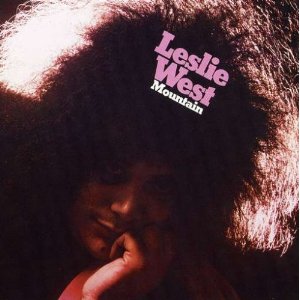
The first album up here is actually a Leslie West solo album, though itself entitled Mountain. It is often regarded as the unofficial Mountain debut, since it not only bears the name, but also features Pappalardi on bass and several tracks which went on to be performed regularly by the band. Pappalardi was involved heavily in the songwriting, and was also producer – a role which he had already notably performed for Cream, an outfit on which West admitted he modelled the original Mountain line-up on. It’s a very strong album for the most part, and deserved of that ‘sort of debut album’ tag, as the tracks Blood Of The Sun, Long Red and Dreams Of Milk And Honey were to go on to be live favourites inextricably identified as Mountain songs. These three are all excellent, as are other standouts such as Blind man, Look To The Wind, Storyteller man and the closing Because You Are My Friend. The drums on the album were handled by ND Smart, who would go on to make up the original Mountain trio.
This new and hungry threesome were actually on the bill at Woodstock – though their non-appearance on the original album and film has resulted in this being unknown to many. That performance is captured in full on the second disc here, and it is a remarkable set from a new band facing a half-million audience, to say the least. Four tracks from the Mountain album are superbly delivered: the opening Blood Of The Sun, Long Red, Dreams Of Milk And Honey and Southbound Train, as well as a take on the blues standard Stormy Monday. There is also a first appearance of the classic Jack Bruce cover Theme For An Imaginary Western, which would get better later, but is already fairly definitive even at this early juncture. Pappalardi’s song Beside The Sea never appeared elsewhere, while the brilliant Waiting To Take You Away is the only released recording of it (along with Long Red, its performance here was included on the later live album The Road Goes Ever On, whose tracks are split between appropriate discs here, but all included. The track For Yasgur’s Farm, which would appear on the next album, is performed here in its original incarnation of Who Am I But You And The Sun, before being reworked lyrically and retitled to commemorate Max Yasgur, the man whose farmland was the venue for the Woodstock festival itself. The show closer (pre-encore) of Dreams Of Milk And Honey is a little drawn out with West’s soloing, but other than that this is all strong stuff, and shows a band who got right into their stride almost immediately. It’s a great recoding to have, and very welcome here indeed.
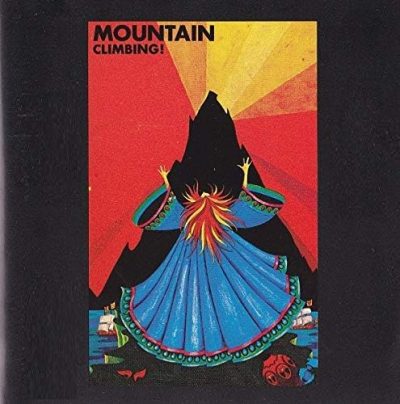
In 1970, the first actual Mountain album appeared, the appropriately titled Climbing! (complete with exclamation mark). Several Mountain staples made their first appearances here, not least the opening Mississippi Queen, which has remained one of their signature tracks. The run of tracks following this is sublime, with Theme For An Imaginary Western, Never In My Life, Silver Paper and For Yasgur’s Farm making a run of five classic tracks on the bounce. Things do tail off a little after this, with The Laird being rather a slog, and none of To My Friend, Sitting On A Rainbow or Boys In The Band being top drawer material, though certainly not poor. Overall it’s a strong debut, with a sublime first half, but better was soon to come. The disc is rounded off by two live tracks – an excellent For Yasgur’s Farm and a rather over-extended Stormy Monday which is a little hard to wade through. I’m not really sure why they were so attached to that one, but it is what it is. The next album was really going to be interesting, mind you…
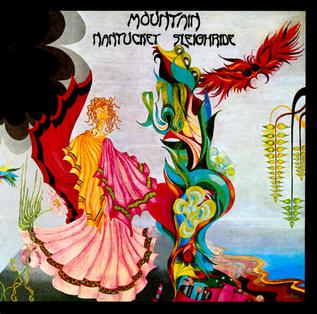
Early 1971 brought us what many (including probably myself) regard as the band’s finest studio hour – the Nantucket Sleighride album. Dominated in retrospect by the title track (the band’s most well known along with Mississippi Queen, at least in the UK where it was used for over a decade as the end theme music for the widely-viewed Sunday current affairs show Weekend World), it makes sense to look at that song first. At around six minutes or so, it is a marvellously varied piece by Pappalardi, alternating between beautifully melodic lyrical sections and the massive steamroller of a riff which is topped off by Steve Knight’s keyboards. Describing a whaler on a long hunt, a Nantucket Sleighride is a term used for a ship being pulled along quickly and dangerously by a whale it has harpooned. The dedication ‘To Owen Coffin’ relates to a true story of such a ship being wrecked, and the survivors (including the young, and unfortunately named Coffin) being reduced to killing and eating one of their crew. The details are well worth an internet search, as it’s a fascinating if grim story. There are plenty of other highlights here – opener Don’t Look Around is propulsive and driving, and another West powerhouse which ranks among the band’s best work. Travelling In The Dark (with dedication to EMP, Felix’s mother) is another great melodic yet heavy track, while Tired Angels (the dedication ‘to JMH refers to Hendrix) and Pappalardi’s ode to his wife Gail Collins, My Lady, are two other reflective highlights, while The Great Train Robbery is a rollicking tune inspired by the UK robbery by Ronnie Biggs and his crew in the early ’60s. The Animal Trainer And The Toad is a little plodding, but is lyrically notable for the fact that those characters are the band’s own nicknames for Pappalardi and West respectively! By this time, Gail Collins was assuming more and more of a profile, co-writing most of Pappalardi’s songs, painting the album covers and generally breeding some resentment in West for her ubiquitous presence. He said that he never fully trusted her, something which was sadly borne out in 1983 when she shot and killed Felix Pappalardi, but that is another story.
The band followed this up at the end of 1971 with Flowers Of Evil (whose cover image is used for this box set), which many claim to have showed the band beginning to run out of steam, as it was a split recording between one studio side and one live side. That may well be true, but for all that it remains an exceptionally strong release, which to these ears has always been up there with Nantucket Sleighride for its quality. The studio side is a feast for lovers of Pappalardi’s contributions as he wrote all of the songs (with Collins of course) – albeit with the opening title track a co-write with West. That title track itself, dealing with traumatised Vietnam soldiers and the widespread hard drug problems endemic in them at the time, is a lyrical and musical tour de force, with West taking the crunching verses and Pappalardi the gentler choruses, and it is as close as anything to a pure distillation of the Mountain magic in a single song. After the short King’s Chorale instrumental, we get three pieces of classic material from the Pappalardi pen. One Last Cold Kiss is a fantasy-themed tale which draws on some almost progressive influences to great effect, while Crossroader is a piledriver of a mid-paced rolling rocker which would become even stronger in concert. Finally, the prog element comes into its sharpest focus with Pride And Passion, which takes the One Last Cold Kiss template, opens it out more expansively, and finishes the side in grand style. The live side, by contrast, is almost all dominated by West. The lengthy 20-minite-plus Dream Sequence is in fact a medley containing a riotous run through of Roll Over Beethoven and a great take on Dreams Of Milk And Honey, augmented by instrumental sections which sound partly improvised but all work as a cohesive whole. Finally, a great version of Mississippi Queen rounds off a lengthy side, and an overall lengthy album, which is a remarkably consistent listen. The disc is completed by the remaining two tracks from the live The Road Goes Ever On album – a definitive, crunchingly heavy Crossroader and a 17-minute Nantucket Sleighride which, despite its central riff not being quite as effective as the studio counterpart, holds together brilliantly as an extended piece.
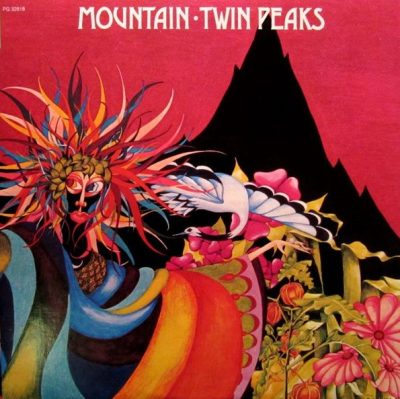
After a tour to promote the album, the band broke up, reforming a year later for further live work, but without drummer Corky Laing or keyboard man Steve Knight. The main pair were joined by Bob Mann on guitar and keyboards and drummer Allan Schwartzberg. They issued a double live album recorded in Japan entitled, quite appropriately, Twin Peaks, which came from recordings in Osaka in August of 1973. Being a double, with the breadth of material it possesses, it would be hard to argue against this as being the best officially released Mountain live album of all. You get Never In My Life, Blood Of The Sun, Silver Paper, Crossroader and of course Mississippi Queen – all delivered superbly. Crossroader in particular is fascinating as it is arranged a little differently, and instead of slamming straight into the riff like the Road Goes Ever On live version, it instead builds up slowly from a restrained beginning to a hugely powerful rendition by the time it is into its stride. There is also the finest rendition of Theme For An Imaginary Western bar none – everything comes together in this performance, from Pappalardi’s beautifully delivered vocal to West’s astonishing guitar solo. If you want to demonstrate to someone why Mountain were so special, just play them this one. Now, there is also the elephant, or the whale, in the room – in the shape of the 33-minute Nantucket Sleighride. So long it took up two whole sides of the vinyl version, it is obviously a little over-extended, and lacks the focus of the previous 17-minute live performance – however, the execution of the core ‘song’ part is magnificent, and I would argue that the classic riff has never sounded better. If you do a little judicious editing of your own, you might just be left with the best version ever. Though some significant noodling would certainly have to be excised, without doubt.
After this, Mann and Schwartzberg departed, with Laing returning for more live work and the final album in this set, 1974’s Avalanche (jeez, enough with the mountain puns now guys!). This one was not recorded in the best environment, with the band having admitted that they felt strained for inspiration, and it often gets written off as a failure – however, it is actually better than its reputation. The real standout is Pappalardi’s Sister Justice, which can hold its own with the very best of their material, but there are other highlights. The sinuous Swamp Boy and the infectious groove of Thumbsucker for two, but also West’s You Better Believe it and the slowed-down, grindingly heavy reimagining of the Stones’ Satisfaction are all well worth the price of admittance. It does tail off a little, with I Love To See You Fly and Back Where I Belong both carrying a strong note of filler about them, but while it might be the weakest of the band’s albums, it is still a worthwhile listen.
Following this the band split, and though West would revive the band a decade later, this would be without the by-then deceased Pappalardi, and the magic was never really recaptured in the same way. This set, however, is an essential listen for anyone not in possession of all of the albums already – and even those fans might be tempted by that Woodstock performance and the other non-album live bonuses. West and Pappalardi really were the Lennon and McCartney or Davis and Hodgson of American heavy rock, and the alchemy on display between them shows exactly why. Much overlooked, and much missed. Great band.