Roaring Forties is the real gem in the basket here, that is something which cannot be denied, but each album here has its moments of brilliance which makes it essential to own for the Hammill devotee.
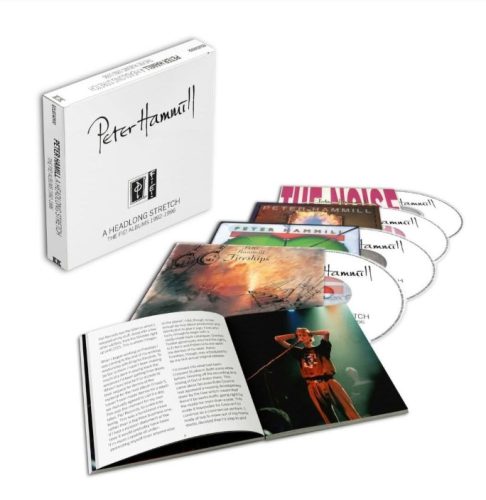
In the 1990s, Peter Hammill set up his own label imprint, the oddly named Fie! (named after the archaic expression meaning to dismiss something, and referring to his major label career), to release his continuing prodigious catalogue of solo albums. Between 1992 and 1996, four albums appeared on Fie!, and it is probably fair to say that they were not the highest profile of his recordings from a mainstream point of view. That fact has been redressed here by the release of all four of the albums in question, in a clamshell box containing the four discs in individual miniature sleeves, and a very informative booklet with an essay penned by Peter himself. I personally, even as a fan of Hammill (and Van Der Graaf Generator especially) had only been familiar with the first of these, 1992’s Fireships, having been fairly cool on it at the time and hence not investigating further – so this represented a chance for me to not only catch up with what I had missed, but also prepare myself for a serving of humble pie if the aforementioned Fireships proved a triumph! Having not heard it since 1992, my mind was a blank slate. So, let’s dive in and have a look into it…
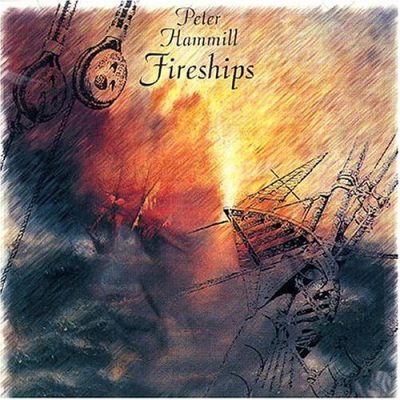
So, as already stated, the big initial question was, did I write off a masterpiece in the shape of that Fireships album over 30 years ago? Well, in truth, not exactly, though it is significantly better than my memories of it from the time when I had inconceivably just turned 30. A rather subdued album for the most part (and noted by Hammill as the first in a planned ‘BeCalm’ series of albums intended to alternate with the contrasting ‘ANoise’ series), it does not quite stretch to the ‘ambient’ description which my younger self had labelled it with, though it does dip its toes into that pool in places without doubt. As with all of these albums, there is a direct VDGG connection, with David Jackson appearing on all four, and Nic Potter on three, and as would be expected, it is the former who lends the most Generator-like touches to the material. The opening track to this one, I Will Find You, is actually atypical of the record as a whole, being a fairly uptempo, lively and relatively mainstream piece, and it is an excellent opener. Things get more mellow in mood after that, and perhaps some light and shade is missing, but there are considerable highlights, such as the emotionally raw story in Curtains and the appropriately exotic instrumental flavourings of the delightfully sinuous Oasis. The title track is perhaps the best thing here, achieving a difficult trick of being simultaneously almost ambient in approach yet also an earworm – you may well find yourself muttering ‘We think we’re fireproof / We never think that we’ll get burned’ to yourself for some time afterward. Given Time is also a rather lovely melodic song, while His Best Girl exemplifies Hammill’s unerring ability to be emotionally devastating when listened to in the right (or wrong) frame of mind. Things perhaps go a little too much to the meandering side, with the title-track referencing Reprise and the slightly overlong, if nicely done Gaia – but all in all it is certainly a better album than my unreliable younger self had led me to believe!
Next up, 1993’s The Noise, is unsurprisingly the polar opposite of that release. Intended as the first in the ‘ANoise’ series (neither of those ideas went past a single entry), it is a far more rocky, full-band affair, and for the most part is excellent. Indeed, there are a couple of certified Hammill classics on here. Like A Shot, The Entertainer is another insanely catchy, yet far from musically simple track, with thoughtful lyrics concerning the subject of ego gratification, and ‘what entertains the entertainer’. Even better is the extended closer Primo On The Parapet, which opens in reflective fashion before exploding into a marvellous full-band groove which is irresistibly propulsive. It’s one which can easily stand up with any part of Hammill’s lengthy career. There isn’t really a poor track here, but the strongest of the others are the title track, the anti-commerciality and anti-homogeneity diatribe of The Great European Department Store, and the lyrically fascinating Planet Coventry. Once again, there could be an argument that the contrasting colours are also a little absent wih this more, well, ‘noisy’ release, but that absence even if present is certainly felt less keenly than Fireships.
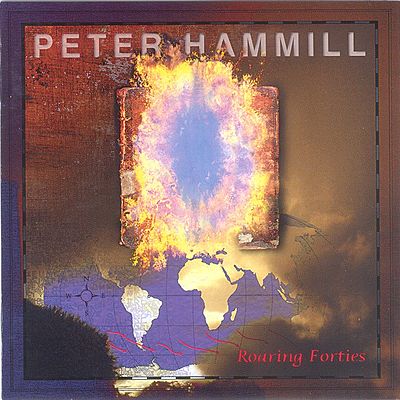
Following that release, the ‘BeCalm’ and ‘ANoise’ concept was abandoned, with the plan being to return to a limitless freedom for any mood to drive the music – and thus we come to what is to my mind the best album here, 1994’s superbly balanced Roaring Forties. Following a nicely tricky and VDGG-like Sharply Unclear opens proceedings, we are thrown into the two-part The Gift Of Fire, being a short introductory section (Precursed) and the main song proper (Talk Turkey). This is a classic as soon as it kicks into gear, being irresistible in its momentum and even swing – and it sweeps you along with its momentum. A marvellous track, and one which embodies the ‘Noise’ side of things. After that, and closing what would be the first side if this were vinyl, is another piece separated into two parts, You Can’t Want What You Always Get… and …If You Haven’t Got It Yet. Now, this may sound like the Rolling Stones devising a tongue-twister, but that is where any resemblance to that similarly-named Stones track ends. In fact, while this is split into two, there is no need for it to be, as the second part is essentially an instrumental coda to the first – and is in fact the best part of the piece as a whole. You’d never want to play the first part without the second, as it would be like half a song. After a fairly rocky first half, we are deep into impenetrable Hammill ‘prog’ territory next with the lengthy seven-part suite A Headlong Stretch, which takes its cue directly from Flight, and even A Plague Of Lighthouse Keepers before it. Once again, I personally would not have indexed the seven parts as individual tracks, as they are clearly intended to fit together as a whole, but I suppose it does help keep track of which part is which. It’s a splendid piece, managing the trick which both of its illustrious longform predecessors did, of seeming like a single cohesive entity despite consisting of parts which are in some cases very different. There are all sorts here, including one classically VDGG section to delight fans of the Hammill ‘Mothership’, and of course there is an oblique lyric with which to wrestle one’s interpretation. It doesn’t quite end the album, however, which finishes with the stately ballad Your Tall Ship, something of a tribute by Hammill to his recently departed father – and it’s a perfect note on which to finish a real highlight in the Hammill catalogue overall.
The final disc here, 1996’s X My Heart, again mixes the loud and the quiet, though not as successfully. It actually opens and closes with two versions of the same song, A Better Time; the first being an Acapella version featuring just Hammill and backing vocals. One can see why he did this, as not only is it the best song on the album by a considerable margin, but also the Acapella rendition does, as he states in the notes, allow the excellent backing vocal arrangement to be featured prominently rather than overlooked. This being the CD age, however, I would have gone with the option to make it a bonus track, because the full version (piano and orchestration) which closes the album is breathtaking in its emotional impact. As it is, even having already had a sort of ‘spoiler alert’ with that opening version, it still closes things in stunning fashion, but without it having already been previewed and slightly blunting its impact, might have been even more so. The rest of the album cannot quite match up – there are strong song ideas here, such as A Forest Of Pronouns, the delicate Earthbound and Material Possession (with its surprising proggy Celtic/folk feel in its instrumental sections), but on occasions (those latter two being examples), the songs are stretched out to five or six minutes when one feels their natural length would be three or four for maximum impact. This one and Fireships are the weaker two to my ears here, but almost anything can be forgiven for something as sublime as that orchestrated A Better Time.
Probably few would claim this to be the finest run of Hammill albums over his long career, but having been introduced to them very belatedly (and reintroduced to Fireships), they certainly make a better listening experience than you might imagine if you have (like me) previously written off the period. Roaring Forties is the real gem in the basket here, that is something which cannot be denied, but each album here has its moments of brilliance which makes it essential to own for the Hammill devotee. Dive in for a Headlong Stretch, and see how you find it – I suspect that, like ‘The Entertainer’ in that song, you will be very much entertained. Treasure Peter Hammill while we have his talent among us – he is one of the few creative artists for whom I reserve the title ‘genius’.


No comments! Be the first commenter?