
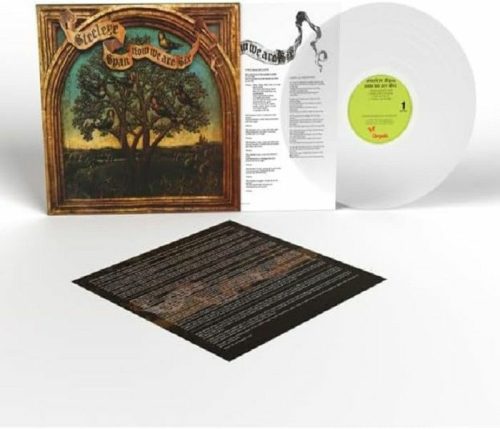
1974’s Now We Are Six represents a true pivotal moment in the career of Steeleye Span, its title not only referencing it as their sixth album, but also their first as a six-piece, following the addition of their first permanent drummer in the shape of Nigel Pegrum, and is here lovingly reissued on CD and clear vinyl … As a result, the album is simultaneously a leap forward for the band, while also arguably showing some signs of settling in to this rather new approach
When people talk about the folk-rock scene in the UK in the 1970s, two names are always invoked: Steeleye Span and Fairport Convention. And for good reason, as they were certainly the best known standard bearers of that particular movement, despite the presence of the likes of Pentangle, Silly Wizard and Ireland’s Horslips all also doing sterling work. Even taking that Steeleye-Fairport axis as the two-pronged lead of the movement, however, there are significant differences. Granted, both tended to favour the English traditional folk catalogue, with Horslips taking the Irish legends and Silly Wizard their own Scottish heritage, but they did not approach things the same way or at the same time. Fairport, of course, began in more of a West Coast mode, their first couple of albums echoing Crosby Stills And Nash as much as any English folk heritage. In fact, the band’s real conversion to traditional folk came with Dave Swarbrick’s initial guest appearance on A Sailor’s Life from the Unhalfbricking album. Their folk masterpiece Liege And Lief followed, and their name was cemented into folk-rock legend. Steeleye, on the other hand, began their career very much in a traditional folk place, continuing the Fairport link by virtue of being founded in 1969 by Ashley Hutchings, who had left Fairport following the Liege And Lief album, wanting to remain more traditional in musical focus. From that moment on, the two bands moved in opposing directions, with Fairport mostly writing their own material only partly influenced by traditional folk, whereas Steeleye gradually evolved from their more traditional roots to embrace a greater and greater rock influence, yet always anchored in the field of traditional arrangements rather than their own compositions for quite some years.
1974’s Now We Are Six represents a true pivotal moment in the career of Steeleye Span, its title not only referencing it as their sixth album, but also their first as a six-piece, following the addition of their first permanent drummer in the shape of Nigel Pegrum, and is here lovingly reissued on CD and clear vinyl. The previous two albums, Below The Salt and the brilliantly experimental Parcel Of Rogues had nudged the music along in a rock direction, leading to the decision to go down the drums and ‘full rock band’ route. As a result, the album is simultaneously a leap forward for the band, while also arguably showing some signs of settling in to this rather new approach. The material was still all based around traditional folk songs, but arranged and moulded in an astonishingly creative way to have feet simultaneously and seamlessly in the folk and rock camps. Influenced by the template of Liege And Lief it certainly was, but even by this time the way Steeleye (and in particular the often overlooked guitarist Bob Johnson) constructed the arrangements was arguably of a greater complexity and ambition. There were also two or three slightly unnecessary novelty tracks added to fill things up a little, but we will come to that. With founder members Maddy Prior and Tim Hart now joined by Pegrum, Johnson, bassist Rick Kemp and violinist and multi instrumentalist Peter Knight, this sextet was to become their ‘classic’ line-up, remaining together for a stellar run of albums, and a reunion after only a couple of years apart. In some ways, it all starts here.
The album opens in classic fashion with Seven Hundred Elves: matching studio trickery, the brilliantly traditional voice of Maddy Prior and some heavy work from Johnson and the rhythm section, the track perfectly straddles the band’s tightrope of ‘is it rock? is it folk?’ so well that it would define the album. From that, however, we get a more traditionally favoured approach on the bawdy tale of saucy milkmaids (they are always maids in folk, with the men always sailors!) with Drink Down The Moon, which wends its way through a cleverly developing arrangement. With instrumentation gradually being added to the initial quietly balladic style as the piece continues, as if the rock influences are inserting their tendrils by stealth, a rollicking version of the other traditional piece The Cuckoo’s Nest is appended seamlessly onto the end. Overall, the skill and subtlety of the arrangement makes it almost a folk-rock Stairway To Heaven, with the Cuckoo’s Nest section at the end a parallel to the way the Zeppelin song takes the same journey into a powerful rock coda. As a teenager, when I first heard the album, this song was never a favourite of mine, but time and evolving musical appreciation have resulted in my seeing it as a cornerstone of the album. There is a short detour into one of those ‘novelty’ pieces next, with the title track consisting of three well-worn riddles being delivered by a school choir – though it is actually in fact the band members imitating the voices of the children (the clue is its crediting to The St Eleye Primary School Choir’ accompanied by ‘Mrs Knight’ on harmonium!). It’s pleasant enough, and doesn’t overstay its welcome, but takes us into the Side One closer, and the piece many believe to be the true classic from the album.
Thomas The Rhymer, over its almost seven minute duration, owes as much to progressive and hard rock as it does to folk in the complexity and brilliance of its arrangement. It’s a little bluntly delivered in the verses, but taken as a whole it can be seen as a song which defines the band’s whole sound and mission statement. It appeared in this full version on the original UK album, but scandalously for the US version, as well as several other overseas territories, it was replaced by a single edit at little more than three minutes, which butchered the song. Happily, after the edited version even appeared on several previous CD reissues of the album, it is restored to its full length here, both on the vinyl and CD editions. It’s a great side of music overall, with only the occasional hints in the heavier sections of Pegrum being initially used as a little more of a battering ram than as a subtle percussionist, but with an entirely new instrument brought in, some finding of their collective feet was understandable, as we are literally listening to them coming of age, as it were.
The second side lacks the big hitters in the band’s catalogue to the same extent, but still contains some fine music. The opening The Mooncoin Jig may go on just a little too long, but it showcases Knight’s hugely impressive mandolin playing (the man could turn his hand to anything!) and the added drive Pegrum could bring to a traditional jig to perfection. Edwin, following this (though credited wrongly as being on Side One on the original cover, reproduced here) is a good old ‘murder ballad’ in the grand tradition. Servant maid (of course) Emma is an item with Edwin, the bold sailor (naturally). He returns from sea and making his fortune to stay in her house, but her parents disapprove. Now, one might think that this might involve a stern talking to, or even ejecting him from the house, but they decide to go with the other option: as soon as he goes to sleep, they enter his room, decapitate him, remove the corpse and throw it – both pieces of course – into the sea. It’s fairly harsh justice admittedly, but that’s the old English murder ballad for you. Emma, unsurprisingly, is not precisely informed of this slaughter that she seemingly slept through, but is told that he has, unfortunately, died, and is in the sea. Not half, as you might say. The tragic hits keep on coming, as she fails to control the grief this brings, until she loses her mind and is taken off to the Bedlam asylum, where ‘her shrieks are for young Edwin, who ploughed the lowlands low’. Parents of the year there, I’m sure we can agree. The musical accompaniment to this tale of grisly murder is excellent again, being a nice blend of the rock and folk, and it also exemplifies one of the charms of Steeleye material: the way they would keep the trademark folk song habit of simply adding in extra words where required to make a line scan or rhyme. It makes all the difference to the integrity of the material when a phrase such as ‘the lowlands low’ – as opposed to ‘the lowlands high’, up in the mountains – is retained and used. You feel as if you’re listening to folk music faithfully reworked, despite the instrumentation.

The utter misery continues with Long A-Growing, a very traditional sounding piece musically, which tells the story of a young woman who is promised to a boy, and for whom she will have to wait while he is ‘a-growing’. She doesn’t like this, but indeed waits, and eventually marries him when he reaches 16 and bears his child when he is 17. Naturally, things don’t end happily, and as expected, by the time he is 18 ‘cruel death’ takes him and ‘puts an end to his growing’. Of course it does. Nobody ever accused English folk song of being a barrel of laughs, after all. Happily the mood is lifted by the far more upbeat Two Magicians, a roistering, almost pure folk song about a duel of magic between a female wizard, who is determined to keep ‘her maidenhead’ (don’t they all?), and her male rival who is determined to take it (once again, don’t they all?). It’s a song which, despite having a real tongue-twister of a chorus, will burrow its way into your head as an earworm as sure as woman are maids and men are dastardly sailors. There’s even another of those marvellous ‘extra word’ examples, with the line ‘and be buried all in my grave’, as if there is some alternative offered involving only partial interment for some reason. Great stuff.
If the album had finished here it would be a perfect ending, but unfortunately we now have the wholly jarring and very odd ending to proceedings. First off we get another of those fake-children’s-choir efforts, this time being a toe-curling rendition of Twinkle Twinkle Little Star. Yes, that one. It’s mercifully short at least. Then to close the album, there is a sharp left turn from medieval folk into 1950s doo-wop, with a cover of To Know Him Is To Love Him, which could be renamed ‘To Hear It Is To Skip It’. Granted, it does echo the good-time rock and roll encores that the band did live at that time, but it’s not a great moment musically, and not helped by the guest star presence of David Bowie on parping saxophone. Only in the ’70s would you seek to engage the services of Bowie and get him to play sax! A curiosity these last two tracks may be, but length wise it doesn’t need them (the US version was sufficiently long despite losing over three minutes of Thomas The Rhymer after all), and they can be happily skipped.
As stated earlier, the album is available in vinyl and CD options, with the CD having a handful of bonus tracks, which is what will influence your preference. Those bonuses consist of that single edit of Thomas, which you don’t want, along with four BBC session tracks, which you do. Oddly Seven Hundred Elves is not included, but the band deliver excellent versions of Edwin, Long A-Growing and Two Magicians, which arguably improve on the album versions, particularly the latter which is joyously delivered. The last track is a very odd Thomas The Rhymer, being a shortened version played straight through, taken at a breakneck pace which has it all done and fading out after two minutes and 52 seconds, similar to the edit but even shorter. It’s very well played, and the tempo change is interesting, but one wonders why. The vinyl version, however, is definitely the way to go if you aren’t desperate for those bonuses, coming in heavyweight clear vinyl, with the original inner sleeve faithfully reproduced (with the lyrics still in completely the wrong song order), but also containing an insert (also contained in the CD booklet) containing the thoughts of the surviving band members Prior, Knight, Pegrum and Kemp, together with Ian Anderson, who produced the album. It’s an illuminating read, and an excellent addition.
Hopefully some more vintage Steeleye will get this treatment, as the following Commoners Crown, All Around My Hat and Rocket Cottage will all see their own 50th anniversaries over the next couple of years. A true English treasure in the world of folk rock music, and a band who have remained brilliantly true to their traditionally inspired roots even in their own songwriting over the decades, I can’t wait to check out the next lot!


