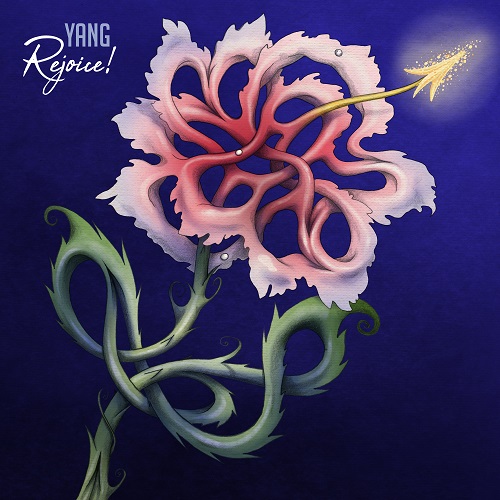
Yang is a French quartet which according to their label’s press release ‘has a history of creating complex yet accessible progressive rock’. To describe them as ‘accessible’ might raise an eyebrow to those familiar with their music. This, Yang’s fifth (and admittedly most accessible release) is still a tough listen at times. Only one of the thirteen tracks struck me as immediately accessible, and that’s the lengthy (near eight-minute) instrumental Concretions. It opens gently and acoustically, leading to the main theme – a lovely rolling guitar phrase which forms the backbone over which guitarist Laurent James weaves a second guitar line. This is broken by a central section with a shimmering minimalist sound. The rolling theme inevitably returns for the climax to conclude this relatively simple song that is full of warm attractive textures. It’ll stick in your mind after one listen and certainly qualifies as ‘accessible’.
In contrast to Concretions is the opener Step Inside which is built around a repetitive guitar phrase. The two guitarists play off against each other and the music progresses in an unsettling way amidst key changes, overlapping rhythms, and something of a jazz-rock feel. There seems to be an emphasis on ensemble playing, with guitars unusually low in the mix, and there is no showboating or flashy guitar soloing. ‘Accessible’ is definitely not a word that would describe this piece. That’s not to say that it isn’t a good track. The soundscape is certainly an intriguing and original one, and while the ‘progressive rock’ label is fair enough, it’s more at the experimental/art-rock and jazz-rock end of the spectrum.

While Yang are an instrumental band, for this release they have brought in a guest singer, Carla Kihlstedt. Her contribution is a bit of a mixed bag. Her singing is mostly in English, although sometimes she slips into French which suits the mood and style of the French band. The song Entanglement is one of the highlights of the album, thanks not only to a lush bed of acoustic guitars but also to a strong melodic line and an emotional delivery by Kihlstedt. On the other end of the scale Kihlstedt goes for a less interesting dreamier and discordant art-rock approach on the very weird track La Quatrième Mort / La Vie Lumineuse. Kihlstedt provides a vital contribution to Get Lost, which to these ears is the standout track on this set. There’s a lovely acoustic opening, out of which a gentle guitar-picked theme emerges. That magical mood is sadly dispelled by some slightly dull male vocals (Laurent James, I believe, who does not have a strong voice), before Kihlstedt enters with her own layered vocals, with the melody being the same as the picked guitar theme. That melody dominates the remainder of the song as it builds gradually to a powerful conclusion.
Other strong tracks are Light As A Cloud, which is one of the few where an instrument (the guitar) breaks out into a clear solo, and the angular jazz-rock riff of Strange Particles. The eleven-minute The Final Day that closes the album builds up promisingly before slightly losing its way. The return of the chorus though is powerful and concludes the piece in a satisfactory manner.
Rejoice! had a duration of an hour and a quarter and the quality does vary. This isn’t just the normal case of there being some slightly weaker songs. Take the track Fire And Ashes, which is so full of unpleasant discordant music that you sense this was the band trying to do something to demonstrate their art rock chops irrespective of whether it might be painful listening for the average music fan.
There’s undoubtedly brilliant musicianship displayed throughout Rejoice!, and some genuinely excellent material. Kihlstedt also adds an extra angle to the band and brings its sound slightly closer to the mainstream. To these ears though, it’s a little frustrating that the band has not been more selective with the material. I can’t help thinking that the best tracks on Rejoice! would have made an impressive forty-minute album, and that’s been slightly spoilt by being stretched to nearly twice that length. But there’s still plenty of quality here, and progressive rock fans looking for something at the art-rock/jazz-rock end of the scale should check it out.


No comments! Be the first commenter?