Every prog band worth their salt really should do a double album, shouldn’t they?
Jem Godfrey
A double concept album. Uh oh! The mere mention excites some and worries others. Will it be a band’s crowning achievement, with flawlessly executed and compelling storytelling? Or will it suffer from excess, filler, and bloat, with listeners worldwide opining about what should have been cut? Partway through my first listen of Life in the Wires, the hefty new release from Frost*, I must admit to breathing a sigh of relief. If there’s one thing a reviewer never wants, it’s disappointment. It’s no fun to write about, it’s even less fun to read, and it can lead to dancing around glaring issues in order to find ‘something nice to say’, which is disingenuous and misleading. Nor does anyone want to go into detail about music that’s simply more of the same from a band long past their prime… and let’s face it, there are more and more of those lately. Thankfully, none of that is the case here with this splendid new album, which I now write about with genuine enthusiasm.

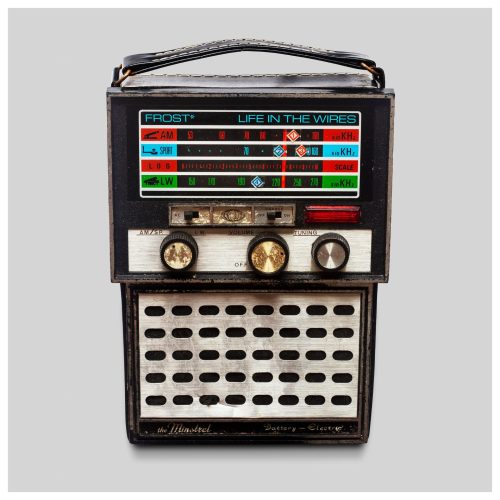
With bandleader Jem Godfrey once again joined by John Mitchell on guitar (he-of-the-many-many-bands), Craig Blundell on drums, and Nathan King on bass, and with an album concept swirling around his head, pen was duly put to paper, and this week the world sees the fruit of that labour, as the Frost* catalogue grows by another 80 minutes or so (yes, this is a double album in the old school 2 LP format, rather than some modern bands who put out whopping 160 minute releases on two jam-packed CDs). The tale told in Life in the Wires is of the young Naio, who is growing up in a not-too-distant future swamped by AI, and who finds an old radio spouting the crackling sounds of a DJ called ‘Livewire’, which of course he is drawn to. Not a terribly ambitious premise at first glance perhaps, until one considers that it also has to be pulled off well – and it is. Musically, the album is less about the rawer sounds or thumping electronica occasionally explored by Godfrey & co. in the past, and considerably more in the polished modern prog rock style of Milliontown, the band’s acclaimed debut album from 2006 (where Godfrey also performed the lead vocals, as here). To be frank, albums like Falling Satellites and Experiments in Mass Appeal have their moments, but have not exactly been yanked off my shelves on anything resembling a regular basis since their respective release dates. But Milliontown has, and I can readily proclaim that Life in the Wires will reside squarely in the latter category as well.
Following the unearthly chiming sounds and ghostly voice of Livewire in the brief intro track Skywaving (in fact a tiny callback to the closing track on 2021’s Day and Age), the staccato rhythms of the title track (part 1) kick in, and give way to classic-sounding Frost*. A focus on melodic verses and a bright, catchy chorus are underpinned by tasty drumming from Craig Blundell, who continues to impress every time I hear him (which has been a lot now, so that’s saying something). Frantic keyboard soloing leads to a more impassioned vocal as the song hits its climax and trails off into gentle piano. Mitchell lays down a long, fabulous solo in This House of Winter while the piece shifts underneath him and moves to a beautiful second half that is one of my favourite moments of the record. We then drift into the atmospheric intro to The Solid State Orchestra, a terrific ‘peaks and valleys’ track which builds, explodes, settles, builds, and explodes again, as does the follow-up track Evaporator, which stretches its Frost*-isms into an engaging eight minute journey. In the gentler Strange World, Godfrey sings about that subject as though he’s only just realizing it himself, and the track features a lovely ethereal middle section. In a 180 degree shift, The Idiot Box blares its message like the subject it tackles, alongside heavy riffs and keyboard stabs in a wonderfully appealing and energetic hard rock track.

The mood changes again in the piano-based ballad Absent Friends, a piece which stays comfortably in its lane and ends the first CD on a soothing note. It also doubles as an interlude between the high-octane Idiot Box and the ensuing bonkers instrumental School (Introducing the All Seeing Eye), the opening to disc two, where everyone is able to let loose and play some old-fashioned prog rock… of course, with the customary modern Frost* twist. And the energy doesn’t let up; we soon find ourselves in the land of Propergander, a song propelled by metallic guitars and pounding drums. I found myself drawn into the track Sign of Life, with its orchestral sounds and the poignancy of our protagonist singing ‘I’m hoping that I’ll find a sign of life, but you are just a siren… nothing but a siren.’ Understandably, this piece could get less attention with such competition elsewhere on the record, but it’s one that I’ve found myself returning to a lot. But that competition does rear its head again immediately after.
Into the energy of Moral and Consequence, then, a beautifully layered track with the richest chorus on the album and another boatload of spirited playing over the course of its eight minutes. It’s yet another of the finest tracks in the Frost* catalogue, and wouldn’t you know it, it’s followed by another one, the blazing and intricate epic Life in the Wires (part 2). This 16 minute centrepiece pinballs between the dramatic, the mysterious, and the triumphant with its unorthodox arrangement, galloping rhythms, lightning-fast widdly-widdly solos, and lengthy instrumental sections. In short, everything you want in a powerhouse piece like this. An absolutely spectacular track! Closing song Starting Fires begins as you might expect, sounding like a delicate coda to the album but which blows wide open into its own fully-fledged song. Yes, there’s still some rocking to be done here, folks! Finally, we trail off and are left in the rippling afterglow of this new slab of Frost*.
It’s too early to decide where Life in the Wires sits in the Frost* catalogue, but only because it’s tough to choose between it and Milliontown as the finest work they’ve done. I’ll honestly be surprised if there’s even one disappointed fan. In a year I’ve found particularly underwhelming with regard to new releases, Life in the Wires arrives as something of a saviour; a substantial journey that sails by in seemingly half the time, and a remarkably engaging breath of fresh air, with numerous emotional peaks, big ‘wow’ moments… and no filler. Seriously impressive, lads. I’ve listened so much already, I have Frost*bite.


Thanks for writing this. I agree that the album is great. I wondered when John would do lead vocals. Not complaining but I am so used to hearing him do lead in some trackd
Hi Lorne,
thanks so much for writing such an excellent review! I had the exact same reaction as you with this album, and how good does it feel in this case for our experience to be so unoriginal – it seems everyone who’s heard this just loves it..
I’ve been vicariously reading reviews to hear if people are as speechless on hearing this album as I’ve been, but sadly they’re so underexposed and there’s been a real scarcity of writing on the album. Of the reviews, I’ve found a lot of them to lack detail, and usually talk about the same songs. Your review is my favourite by a huge stretch – the way you were able to make each track shine and come to life through your words has been fantastic. I also really liked how much attention you paid, and how much appreciation you had for the deeper cuts on the album. Thanks for such a great writeup 🙂
Just to note btw that the solo in This House of Winter is actually Jem playing – I love that you picked up on that solo though. That track is just the high point for me, and I think the guitar solo is probably the best one in their catalogue. I love how much energy and buildup goes into it, only for the track to then turn on a dime and develop into such a beautiful instrumental.
Thank you Josh! Nice to have a ‘review of a review’! Cheers.